
From Desk to Calm

Stress Less, Move More, Work Better – From Anywhere

Category: Tips for Success

  • Remote Work Job Search Checklist

    Remote Work Job Search Checklist

    Your Step-by-Step Roadmap to Remote Work Success

    Landing your first remote job without experience can feel overwhelming. You need to build the right skills and avoid scams. Standing out among hundreds of applicants is crucial. It’s easy to get lost in the process. That’s why I’ve created this comprehensive checklist that breaks down everything you need to do into manageable, actionable steps. Whether you’re just starting your remote work journey, this checklist will help you stay organized. Or you’ve been searching for months without success, it will still be beneficial. It will track your progress. It will ensure you’re not missing any critical steps. Think of it as your personal roadmap from “I want to work remotely” to “I just got hired.” Print it out. Check off each item as you complete it. Watch as your remote work dream becomes a systematic, achievable goal.

    Remote Work Job Search Checklist

    Pre-Application Setup ✅

    Skills & Experience Assessment

    • [ ] Completed comprehensive skills inventory
    • [ ] Translated past experiences into remote work language
    • [ ] Identified 2-3 key skills to develop further
    • [ ] Documented specific examples of independent work
    • [ ] Created list of achievements with quantifiable results

    Professional Online Presence

    • [ ] Updated LinkedIn profile with remote work focus
    • [ ] Added professional headshot photo
    • [ ] Optimized LinkedIn summary for remote opportunities
    • [ ] Added relevant skills to LinkedIn profile
    • [ ] Requested skill endorsements from connections
    • [ ] Set up professional email address if needed
    • [ ] Created basic portfolio website or document

    Workspace & Technical Setup

    • [ ] Designated specific work area in home
    • [ ] Tested internet speed (minimum 25 Mbps)
    • [ ] Ensured good lighting for video calls
    • [ ] Organized and decluttered workspace
    • [ ] Tested video calling software (Zoom, Teams, Google Meet)
    • [ ] Set up professional video call background
    • [ ] Taken photos of workspace for portfolio/LinkedIn

    Learning & Skill Development

    • [ ] Enrolled in at least one relevant online course
    • [ ] Completed basic software training for target roles
    • [ ] Practiced typing speed (aim for 40+ WPM)
    • [ ] Learned industry-specific tools or platforms
    • [ ] Obtained free certifications (Google, HubSpot, etc.)
    • [ ] Created work samples or portfolio pieces

    Job Search Strategy ✅

    Target Role Research

    • [ ] Identified 3-5 entry-level remote roles that match skills
    • [ ] Researched average salaries for target positions
    • [ ] Understood typical requirements for each role type
    • [ ] Found growth paths from entry-level positions
    • [ ] Identified transferable skills for each target role

    Company Research

    • [ ] Created list of 20-30 target companies
    • [ ] Researched company cultures and values
    • [ ] Identified remote-first vs. remote-friendly companies
    • [ ] Found employee reviews on Glassdoor
    • [ ] Checked company social media presence
    • [ ] Noted recent company news or developments
    • [ ] Identified key hiring managers or recruiters

    Application Materials

    • [ ] Created remote-work optimized resume
    • [ ] Written 3 different cover letter templates
    • [ ] Developed elevator pitch for remote work transition
    • [ ] Created work samples or portfolio pieces
    • [ ] Prepared list of professional references
    • [ ] Set up application tracking spreadsheet

    Daily Application Process ✅

    Before Applying to Each Job

    • [ ] Read job description thoroughly
    • [ ] Researched the specific company
    • [ ] Verified job posting legitimacy (not a scam)
    • [ ] Customized resume for specific role
    • [ ] Tailored cover letter to company and position
    • [ ] Identified how your skills match their needs
    • [ ] Found contact information for follow-up

    Application Submission

    • [ ] Applied through official company channels
    • [ ] Followed all application instructions exactly
    • [ ] Included all requested documents
    • [ ] Used professional email subject line
    • [ ] Saved copy of application for records
    • [ ] Updated tracking spreadsheet
    • [ ] Set calendar reminder for follow-up

    Post-Application

    • [ ] Connected with company employees on LinkedIn
    • [ ] Engaged with company social media content
    • [ ] Set follow-up reminder for 1 week
    • [ ] Prepared for potential phone/video screening
    • [ ] Researched additional company information

    Interview Preparation ✅

    Technical Setup

    • [ ] Tested internet connection stability
    • [ ] Verified video and audio quality
    • [ ] Downloaded/updated required software
    • [ ] Set up professional background or virtual background
    • [ ] Prepared backup communication method
    • [ ] Ensured quiet, distraction-free environment
    • [ ] Charged all devices and had chargers ready

    Content Preparation

    • [ ] Researched interviewer(s) on LinkedIn
    • [ ] Reviewed company website and recent news
    • [ ] Prepared answers to common remote work questions
    • [ ] Developed specific examples using STAR method
    • [ ] Prepared thoughtful questions about the role
    • [ ] Practiced explaining remote work transition
    • [ ] Reviewed job description and requirements again

    Documentation Ready

    • [ ] Copy of resume and cover letter
    • [ ] Portfolio or work samples
    • [ ] List of references with contact information
    • [ ] Notepad and pen for taking notes
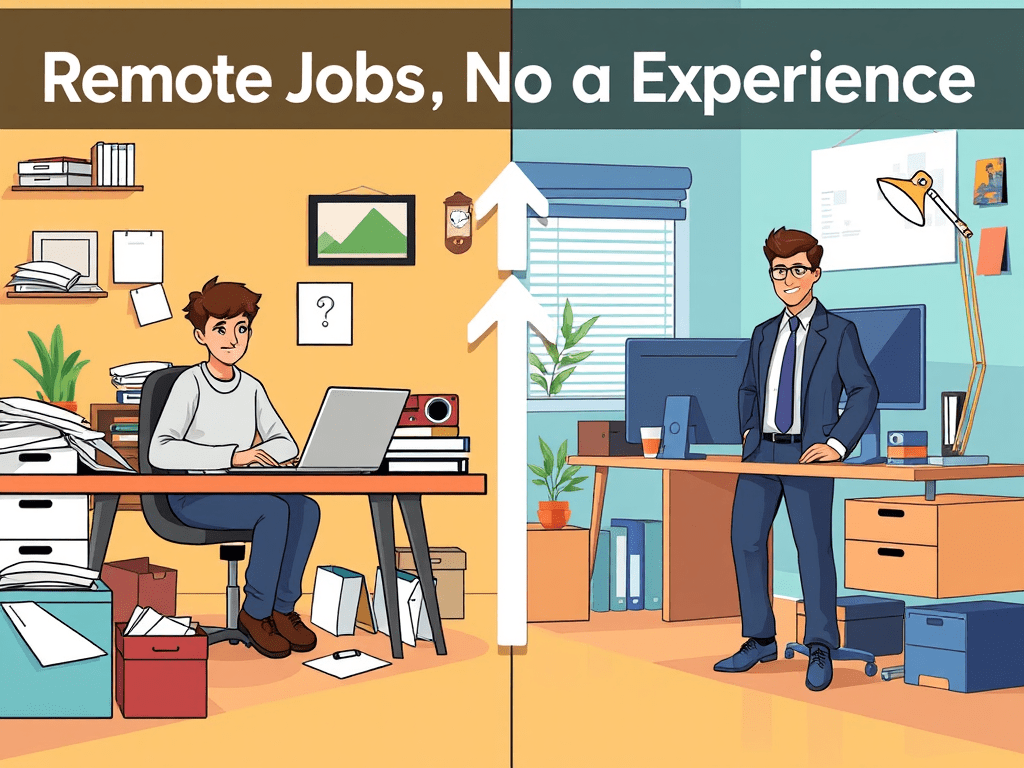
  • Remote Jobs No Experience

    Remote Jobs No Experience

    Hey there! 🌟

    Two years ago, I was scrolling through remote job boards at 2 AM, feeling completely defeated. Every posting seemed to want 3-5 years of experience, advanced certifications, or skills I’d never heard of. I had enthusiasm, a decent work ethic, and absolutely zero remote work experience to show for it.

    The worst part? I kept seeing the same advice everywhere: “Start freelancing to build your portfolio” or “Take on unpaid internships.” Easy to say when you need to pay rent next month, right?

    Then I met Marcus. He is a customer success manager. Marcus landed his first remote role just eight months after being laid off from retail management. No tech background. No fancy degree. No connections in his industry. Just a strategic approach to positioning himself as someone companies wanted to take a chance on.

    His story completely changed how I thought about breaking into remote work.

    The Truth About “No Experience” in Remote Work

    Here’s what Marcus taught me: When companies say they want “remote work experience,” they want candidates with varied remote backgrounds. They don’t want people who’ve only worked from home. They seek individuals who can work independently, communicate clearly, and deliver results without constant supervision.

    The problem isn’t that you lack experience. The issue is that you don’t know how to translate your existing skills into remote work language. Every job you’ve ever had has given you transferable skills. Every volunteer role has provided skills as well. Even managing your own life has contributed skills that remote employers desperately need.

    Companies hiring for entry-level remote positions care more about your potential and work style than your previous job titles. They just need proof that you can handle the unique challenges of working from home.

    4 Strategies to Position Yourself as Remote-Ready

    1. Audit Your Hidden Remote Skills

    You already have more remote-relevant experience than you think. Look for these transferable skills in your background:

    From any job:

    • Project management — Organizing events, coordinating schedules, meeting deadlines
    • Communication — Writing emails, presenting to groups, explaining complex topics
    • Problem-solving — Troubleshooting issues, finding creative solutions, working under pressure
    • Self-direction — Working independently, managing priorities, staying motivated

    From life experience:

    • Planning trips = project management and research skills
    • Managing household budgets = financial analysis and attention to detail
    • Coordinating family schedules = logistics and communication skills
    • Learning new hobbies = adaptability and self-directed learning

    Create a “skills inventory” document listing every capability you have, no matter how you gained it. This becomes your foundation for remote job applications.

    2. Build Proof of Remote Work Capabilities

    Since you can’t show remote work history, create evidence of remote work skills instead.

    Quick wins to demonstrate remote readiness:

    • Set up a professional workspace and take photos for your LinkedIn profile
    • Complete online courses relevant to your target roles (many are free)
    • Start a side project — blog, YouTube channel, small business, volunteer work
    • Document your self-directed learning through certificates, portfolios, or case studies
    • Practice video calls until you’re comfortable on camera

    Communication portfolio building:

    • Write LinkedIn posts about your learning journey
    • Create brief video introductions showcasing your communication skills
    • Offer to help local businesses with their social media or admin tasks
    • Join online communities in your field and contribute valuable comments

    3. Target Entry-Level Remote-Friendly Roles

    Some roles are naturally easier to break into remotely. Focus your search on positions that:

    High-demand, entry-level remote roles:

    • Customer service representative — Most companies offer training
    • Virtual assistant — Wide range of tasks, flexible skill requirements
    • Content moderator — Social media platforms constantly hiring
    • Data entry specialist — Detail-oriented work that’s easy to train
    • Online tutor or teacher — If you have expertise in any subject
    • Social media assistant — Great for digital natives
    • Sales development representative — Many companies train from scratch

    Industries actively hiring remote beginners:

    • SaaS and tech companies (customer success, support)
    • E-commerce businesses (operations, customer service)
    • Digital marketing agencies (assistant roles, content creation)
    • Online education platforms (support, community management)
    • Remote-first startups (various entry-level positions)

    4. Master the Remote Job Application Process

    Apply differently than you would for traditional jobs. Remote employers evaluate candidates through a different lens.

    Application strategy that works:

    • Customize every application — Show you understand their specific remote work challenges
    • Lead with your why — Explain your genuine interest in remote work beyond convenience
    • Address the experience gap directly — “While I’m new to remote work, I’ve demonstrated [specific skill] through [concrete example]”
    • Show initiative — Mention courses you’ve taken, tools you’ve learned, or preparations you’ve made

    Stand-out application elements:

    • Include a brief video introduction (30-60 seconds)
    • Create a simple portfolio website showcasing your skills
    • Write a thoughtful cover letter addressing their specific needs
    • Follow up professionally but not aggressively
    • Be prepared for skills-based assessments or trial projects

    Your 30-Day Remote Job Search Plan

    Week 1: Foundation Building

    • Complete your skills inventory
    • Set up your workspace and take professional photos
    • Update LinkedIn profile with remote work focus
    • Research 10 companies you’d love to work for

    Week 2: Skill Development

    • Enroll in 2-3 relevant online courses
    • Start a small project to showcase your abilities
    • Join industry-specific online communities
    • Practice video calls with friends or family

    Week 3: Application Preparation

    • Create your portfolio website or document
    • Write 3 different cover letter templates
    • Prepare for common remote work interview questions
    • Set up job alerts for entry-level remote positions

    Week 4: Active Job Searching

    • Apply to 10-15 positions per week
    • Follow up on applications from previous weeks
    • Network in online communities
    • Refine your approach based on responses

    Your Challenge This Week 🎯

    Choose one entry-level remote role that interests you and spend one hour researching:

    • What skills do job postings repeatedly mention?
    • What tools or software do they commonly use?
    • What challenges will someone in this role face?
    • How can you start building relevant experience now?

    Then take one concrete action toward building that experience. Sign up for a free course. Download the software to practice. Alternatively, reach out to someone doing that job for advice.

    What type of remote work are you most interested in pursuing? Are there specific skills you’re worried about not having, or companies you dream of working for?

    Hit me up in the comments and let me know. I love helping people navigate their path into remote work. Sometimes, an outside perspective can spot opportunities you might be missing.

    Here’s to proving that passion and preparation can open doors that experience alone will not.

    Talk soon, Tim

    P.S. Remember: every expert was once a beginner. The remote workers you admire today all started somewhere, and many of them started exactly where you are now. Your fresh perspective and eagerness to learn might be exactly what the right company is looking for. 🚀

    Get my Remote Work Job Search Checklist HERE

  • Daily Routines of High-Performing Remote Workers

    Daily Routines of High-Performing Remote Workers

    Hey there! ⭐

    I used to think the most productive remote workers were the ones posting LinkedIn updates at 5 AM. They wrote about their “morning grind” and color-coded calendars. You know the type — up at dawn, green smoothie in hand, crushing goals before most people hit snooze.

    Then I actually started talking to people who consistently deliver exceptional work from home, and I was shocked. The highest performers I met weren’t necessarily early risers or productivity hackers. But they all had one thing in common: rock-solid daily routines that worked with their natural rhythms, not against them.

    Take CJ, a project manager who mentored me early in my remote work journey. I was struggling to fit into a traditional 9-to-5 schedule. I also felt guilty about my afternoon energy crashes. Meanwhile, CJ was quietly revolutionizing how I thought about productivity. He started work at 10 AM, took genuine lunch breaks, and wrapped up by 4 PM sharp. Yet his project delivery rate was unmatched, and his team consistently hit every deadline. His secret? He’d designed his remote work routines entirely around his peak energy windows instead of fighting against his natural rhythms.

    What High Performance Really Looks Like

    After studying dozens of top-performing remote workers, I made a surprising discovery. Success isn’t about having the “perfect” daily schedule when working from home. It’s about having consistent systems that create predictable outcomes.

    The most productive remote workers don’t wing it. They don’t rely on motivation or willpower. Instead, they’ve built productive habits remote workers can depend on, regardless of how they feel on any given day.

    These aren’t complicated systems or time-tracking apps. They’re simple, sustainable routines that create structure in an environment where structure doesn’t naturally exist.

    4 Essential Elements of High Performance Routines

    1. The Protected Morning Window

    Every high-performing remote worker I studied guards their first 1-2 hours fiercely. But here’s the twist: what they do during this time varies dramatically.

    Some common approaches:

    • The Early Bird: Up at 6 AM for exercise, journaling, and strategic planning
    • The Slow Ramp: Gentle morning routine with coffee, reading, and gradual work entry
    • The Power Start: Immediate dive into the day’s most important task
    • The Preparation Ritual: Review schedule, set intentions, organize workspace. This is my most important approach.

    The key isn’t the specific activity — it’s that this time belongs to them, not their inbox or urgent requests. High performers use this window to set their day’s tone rather than react to everyone else’s priorities.

    2. Strategic Deep Work Blocks

    Productive remote workers have figured out when their brain works best and ruthlessly protect those hours.

    How they structure focus time:

    • Time blocking: Dedicated 2-3 hour chunks for challenging work
    • Theme days: Mondays for strategy, Tuesdays for creation, etc.
    • Peak energy mapping: Scheduling hardest tasks during natural energy highs
    • Communication boundaries: Specific hours for emails/meetings vs. solo work. Simple and effective but somewhat elusive for some.

    They don’t try to do deep work all day. Instead, they identify their 3-4 peak hours and build their entire schedule around protecting them.

    3. Intentional Break Architecture

    This was the biggest surprise: high-performing remote workers are strategic about their breaks, not just their work time.

    Effective break patterns I observed:

    • Micro-breaks: 5-minute walks between tasks
    • Movement breaks: Stretching, yoga, or quick workouts every 2 hours
    • Nature breaks: Stepping outside, even briefly, during the day
    • Social breaks: Quick calls with colleagues or family members
    • Creative breaks: Playing an instrument, doodling, or other non-work activities

    They don’t see breaks as “time off” — they see them as fuel for sustained high performance.

    4. The Shutdown Ritual

    Every high performer has a clear end-of-workday routine that signals to their brain: “Work is done.”

    Common shutdown elements:

    • Task capture: Writing down tomorrow’s priorities. I personally look at the next days schedule to help with this.
    • Workspace clearing: Organizing desk and closing programs. In my case, I collect all my post it notes and doodles.
    • Transition activity: Exercise, cooking, or family time
    • Gratitude practice: Reflecting on the day’s wins. I record these for my weekly summary to my boss.
    • Physical boundary: Closing laptop, leaving office, changing clothes. Most days I head right to my garage to grab my lawn mower, of pull some weeds. Its all about clearing my head.

    This isn’t about stopping at a specific time (though many do). It’s about creating a clear psychological transition from work mode to personal mode.

    Building Your High Performance Routine

    Start With Your Energy, Not Your Schedule

    Before you design your routine, track your energy for one week:

    • When do you feel most alert and creative?
    • What time of day do you naturally start to fade?
    • When are you most easily distracted?
    • What activities give you energy vs. drain it?

    Use this data to design your ideal daily structure.

    Design Your Non-Negotiables

    High performers typically have 3-5 non-negotiable elements that happen every workday:

    • A specific morning routine (even if it’s just 10 minutes)
    • One protected deep work block
    • A real lunch break away from screens. I have it blocked off in my calendar yet people still send meeting requests 😱
    • Some form of movement
    • A clear work shutdown

    Start with just 2-3 elements and build from there.

    Create Flexibility Within Structure

    The best remote work routines have consistent frameworks but flexible details. For example:

    • Always exercise in the morning, but vary the activity
    • Always have a shutdown ritual, but adjust timing based on workload
    • Always protect deep work time, but shift the hours as needed

    Test and Adjust Weekly

    High performers treat their routines like experiments. They try something for a week, assess how it felt, and make adjustments. They’re not married to any particular approach — they’re married to the process of continuous improvement.

    Your Challenge This Week 🎯

    Pick one element from the high performance routines and commit to testing it for five days:

    • Design a 15-minute morning routine
    • Block out 2 hours for deep work daily
    • Take three intentional breaks each day
    • Create a simple shutdown ritual

    Don’t try to overhaul your entire day. Just experiment with one piece and notice how it affects your energy, focus, and overall satisfaction with your work.

    What does your current remote work routine look like? Are there patterns that serve you well, or areas where you feel like you’re constantly playing catch-up?

    Hit me up in the comments — I’m curious about what routines you’ve tried and what’s worked (or hasn’t worked) for you.

    Here’s to building systems that make success feel less like luck and more like inevitability.

    Talk soon, Tim

    P.S. Remember: the best routine is the one you’ll actually stick to. Don’t aim for perfection — aim for consistency. Small, sustainable changes compound into remarkable results over time. 🚀

  • Tech-Free Hobbies for Better Mental Wellness

    Tech-Free Hobbies for Better Mental Wellness

    Hey there! 🌱

    Last Saturday, I caught myself doing something surprising. My teenage self would have been horrified. I was genuinely excited about pulling weeds.

    There I was. Dirt under my fingernails. Sweat on my forehead. I was completely absorbed in clearing out the overgrown corner of my garden. I was listening to a podcast on my airpods. No notifications buzzing. No tabs open in my brain. Just me, the earth, and the satisfying pop of dandelions coming up by the roots.

    When I finally looked up, two hours had passed without me checking my phone once. I felt… lighter. Like I’d been holding my breath for months and could finally exhale.

    That’s when it hit me: I couldn’t remember the last time I’d felt that present.

    The Screen-Free Awakening

    Over the past few months, I’ve intentionally sought out tech-free hobbies. I’ve discovered our brains are starving for activities that don’t involve screens. We don’t even realize it.

    After years of remote work, endless scrolling, and digital everything, I started noticing some troubling patterns. My attention span was shot. I felt restless even during “relaxing” activities like watching Netflix. My hands felt twitchy whenever I wasn’t holding a device.

    Sound familiar?

    Reading, sports, and gardening consistently rank among the most popular hobbies globally, and there’s a reason for that. These offline activities give our minds something our digital lives simply can’t: genuine restoration.

    4 Categories of Tech-Free Hobbies That Actually Help

    1. Hands-On Creative Activities

    There’s something magical about creating something physical with your hands. Your brain shifts into a completely different gear.

    Popular options to try:

    • Knitting or crocheting — repetitive motions that calm anxiety. My daughter creates the most amazing creations just sitting watching tv.
    • Pottery or ceramics — working with clay is surprisingly meditative
    • Woodworking — building something tangible feels incredible. I have a small wood shop in my garage. My wife and I have built beds, garden boxes, and even a dining room table there.
    • Cooking or baking — engaging all your senses while creating something delicious
    • Jewelry making — perfect for detail-oriented minds

    The key is choosing something that requires just enough focus to quiet your inner chatter. It should not require so much focus that it becomes stressful.

    2. Movement-Based Hobbies

    Dancing can have significant brain benefits. Research shows this to be true. Social dancing is particularly effective for cognitive health. But you don’t need to become a professional dancer to reap the benefits.

    Try these:

    • Hiking or nature walking — movement plus fresh air is unbeatable
    • Dancing — whether it’s salsa lessons or just dancing in your living room
    • Gardening — surprisingly physical and incredibly grounding
    • Yoga or tai chi — movement that connects body and mind
    • Sports — tennis, basketball, or even just shooting hoops

    The goal isn’t to become an athlete. It’s to get your body moving in ways that feel good and break you out of the sedentary screen cycle.

    3. Mindful Learning Activities

    These hobbies engage your brain in focused, intentional ways that are the opposite of doom-scrolling.

    Consider:

    • Reading physical books — the tactile experience changes everything
    • Learning a musical instrument — piano, guitar, or even a ukulele
    • Puzzles — jigsaw puzzles, crosswords, or Sudoku
    • Board games — with friends or family for added connection
    • Journaling or creative writing — pen to paper, not fingers to keyboard

    These activities train your brain to focus deeply on one thing at a time — a skill that digital life actively erodes.

    4. Connection-Based Hobbies

    Some of the most restorative offline activities involve connecting with others face-to-face.

    Ideas to explore:

    • Volunteering — helping others while building community
    • Hosting dinner parties — cooking for friends combines creativity and connection
    • Joining clubs — book clubs, hiking groups, or hobby meetups
    • Family activities — travel, camping, or even regular game nights
    • Community sports — joining a local league or pickup games

    Offline hobbies are particularly crucial for remote workers. They help enforce work boundaries. These hobbies provide essential mental breaks from screen time.

    Getting Started: Your 3-Step Tech-Free Plan

    Step 1: Audit Your Current “Relaxation”

    Look at how you currently spend your downtime. If most of it involves screens, it’s time to experiment with something different.

    Step 2: Start Small and Simple

    Don’t try to become a master gardener overnight. Start with:

    • A single houseplant to care for
    • A 15-minute walk without your phone
    • One book you’ve been meaning to read
    • A simple recipe you want to try

    Step 3: Notice How You Feel

    Pay attention to your energy levels, sleep quality, and overall mood after engaging in offline activities. The benefits might surprise you.

    Your Challenge This Week 🎯

    Choose one tech free hobby from the list above and commit to trying it for just 30 minutes this week. Not every day — just once.

    Maybe it’s picking up that book that’s been sitting on your nightstand. Maybe it’s taking a walk around your neighborhood without your phone. Maybe it’s finally trying that recipe you bookmarked months ago.

    The goal isn’t to find your lifelong passion immediately. It gives your brain a break from the constant digital stimulation. You will remember what it feels like to be fully present.

    What offline activity have you been curious about but haven’t made time for? Hit the comments below and let me know. I love hearing about people’s rediscovered hobbies. I am also interested in the unexpected ways they’ve changed their daily routines.

    Here’s to dirty fingernails, sore muscles, and the kind of tiredness that comes from doing something real with your hands.

    Talk soon, Tim.

    P.S. If you’re feeling overwhelmed, remember that adding “one more thing” to your schedule isn’t necessary. Tech-free hobbies aren’t about productivity. They’re about restoration. Sometimes the most productive thing you can do is step away from trying to be productive. 🌿

  • Preparing for a productive Work week? Check out these 5 tips to Thrive in remote work.

    Preparing for a productive Work week? Check out these 5 tips to Thrive in remote work.

    Hey there! 👋

    I had one of those Monday mornings last week. It’s the kind where you roll out of bed at 8:47 AM. Then, you stumble to your laptop in yesterday’s sweatpants. Suddenly, you realize you have three back-to-back Zoom calls starting in 13 minutes.

    My hair looked like I’d been electrocuted. My “home office” had papers lying all around and I couldn’t find my good headphones anywhere. By 10 AM, I felt like I was already behind for the entire week.

    Sound familiar?

    What I Learned About Remote Work Rhythms

    That chaotic Monday got me thinking about something I’ve been wrestling with for months: some weeks feel effortless and productive. Other weeks feel like I’m constantly playing catch-up.

    I tracked my habits for a few weeks. I talked to other remote workers. I realized the difference isn’t about motivation or willpower. It’s about having systems that work with the unique challenges of working from home, not against them.

    The most successful remote workers I know don’t wing it. They’ve cracked the code on preparation.

    5 Game-Changing Tips for Remote Work Success

    1. Sunday Reset: Your Week’s Foundation

    This isn’t about meal prep or color-coding your calendar (though if that’s your thing, go for it!). It’s about creating a 15-minute ritual that bridges your weekend brain and your work brain.

    Every Sunday evening, I:

    • Clear my workspace completely
    • Review my calendar for the week ahead
    • Pick out clothes for Monday (yes, even if it’s just a nice shirt for video calls)
    • Set up my coffee station so it’s ready to go

    This tiny investment saves me from those frantic Monday mornings and helps me start strong.

    2. Create Non-Negotiable Boundaries

    Working from home means your office never really “closes.” The laptop is always there, whispering your name at 9 PM.

    The remote workers who thrive have learned to build walls where none exist:

    • Set a hard stop time and stick to it (mine is 5 PM)
    • Use a separate browser or user account for work
    • Physically close your laptop or turn off your screen when you’re done. On the weekends I shut them off to save electricity.
    • Create a “commute” ritual — even if it’s just a 5-minute walk around the block

    Your future self will thank you for protecting your downtime.

    3. Design Your Environment for Success

    Your workspace isn’t just about having a good chair (though that matters too). It’s about creating an environment that signals to your brain: “This is where focused work happens.”

    Small changes that make a big difference:

    • Position your desk near natural light if possible
    • Keep a water bottle within arm’s reach
    • Use noise-canceling headphones or white noise to create audio boundaries
    • Have a dedicated “work phone” spot so you’re not constantly tempted by notifications (this is the hardest one for me!!).

    Remember: you’re not just working from home, you’re creating a professional environment that happens to be at home.

    4. Master the Art of Micro-Breaks

    This one surprised me. I used to think productivity meant grinding through tasks without stopping. But remote work requires a different approach.

    The most effective remote workers take intentional micro-breaks:

    • Stand up and stretch between meetings
    • Step outside for 2 minutes of fresh air
    • Do a quick breathing exercise
    • Look at something 20 feet away to rest your eyes (also, every 20 minutes, focus your eyes on something 20 feet away for 20 seconds)

    These aren’t “productivity hacks” — they’re maintenance for your brain and body.

    5. Build Connection Into Your Week

    Remote work’s biggest hidden challenge isn’t distractions or time management. It’s isolation.

    Even if you’re naturally introverted, humans need connection to thrive. Schedule it like you would any important meeting:

    • Block time for coffee chats with colleagues
    • Join or create a virtual coworking session
    • Take walking meetings when possible
    • Send a quick “how are you doing?” message to a teammate. I do this a lot. (I work for a large organization. I like to keep tabs on people I have grown close to over the years).

    Connection isn’t a luxury in remote work — it’s fuel.

    Your Challenge This Week 🎯

    Pick just one of these tips and commit to trying it for the next five days. Not all five tips — just one.

    Maybe it’s setting up your Sunday reset ritual. Maybe it’s creating that hard stop boundary. Maybe it’s finally getting those noise-canceling headphones you’ve been thinking about.

    Start small, but start somewhere.

    I’m curious: which tip resonates most with you? Or do you have a remote work game-changer that I didn’t mention?

    Hit me up in the comments down below. Let me know your thoughts. I read every response and love hearing what’s working for you. I’m also interested in what’s not working for you.

    Here’s to a week where you feel ahead of the game instead of behind it.

    Talk soon, Tim

    P.S. If you found this helpful, feel free to send it to anyone who will gain from it. We’re all figuring this remote work thing out together. 💪

  • Freelance vs Remote Employment: Which One’s Right for You?

    Freelance vs Remote Employment: Which One’s Right for You?

    Freelance vs Remote Employment: Which One’s Right for You?

    Hey there! 👋

    Six months ago, I was sitting at my kitchen table, staring at two job offers. One was a traditional remote position with a consulting company—good salary, benefits, the whole package. The other was a freelance opportunity that would double my hourly rate but came with zero guarantees and zero benefits.

    I spent two weeks agonizing over the decision, calling every mentor I knew, and making endless pros and cons lists. The choice felt impossible because both paths seemed equally appealing and terrifying.

    If you’re reading this, you’re probably in a similar spot. Maybe you’re tired of the corporate world and dreaming of freelance freedom. Or perhaps you’re a freelancer who’s curious about the stability of remote employment.

    Here’s what I wish someone had told me back then.

    The Real Difference Between Freelance and Remote Work 🤔

    Here’s the thing most people don’t realize: Both freelancing and remote employment involve working from home. However, they are completely different lifestyles.

    Remote employment is like having a traditional job, just without the commute. You have a boss, regular hours, team meetings, and a predictable paycheck. In 2024, 52% of Gen Z professionals took on freelance work. This shows that younger workers are increasingly choosing alternative work arrangements.

    Freelancing is running your own business. You’re the CEO, the sales team, the accountant, and the service provider all rolled into one. The percentage of independent workers serving other businesses rose to 11.2 million in 2024, a 14% increase from previous years, indicating strong demand for freelance services.

    Neither path is inherently better—they’re just different solutions to different problems.

    Four Key Factors to Consider

    After talking to dozens of people who’ve made this choice (and living both sides myself), here are the factors that matter most:

    1. Financial Stability vs. Income Potential

    Remote employment offers predictable income, benefits, and paid time off. You know exactly how much you’ll earn each month. You don’t have to worry about finding your next client. In most cases, you don’t have to worry about your workload either.

    Freelancing can be more lucrative—many freelancers earn 2-3x what they made as employees. But income is unpredictable. You might have a $15K month followed by a $3K month.

    Best for freelancing: You have 6-12 months of expenses saved and can handle income fluctuations.

    2. Control vs. Structure

    As a remote employee, your days are largely structured for you. You have meetings, deadlines, and clear expectations. This can be comforting if you thrive with external accountability. Personally, I love having security.

    Freelancing gives you complete control over your schedule, clients, and projects. But that freedom comes with the responsibility of self-management and business development.

    Best for freelancing: You’re self-motivated and comfortable with ambiguity.

    3. Skill Development vs. Specialization

    Remote jobs often expose you to different projects and learning opportunities within a company. You might develop leadership skills, learn new technologies, or gain industry expertise.

    Freelancing forces you to become highly specialized in your core skills while also learning business skills (sales, marketing, client management).

    Best for freelancing: You have a marketable skill and enjoy wearing multiple hats.

    4. Work-Life Balance Reality Check

    Remote employment typically offers clearer boundaries. When you log off, you’re done. Many companies are also improving work-life balance policies.

    Freelancing can blur boundaries more. You’re always “on” for business development, and the pressure to take every opportunity can lead to overwork.

    Best for freelancing: You’re comfortable setting your own boundaries and saying no to work.

    Your Challenge This Week 🚀

    Before making any major decisions, try this exercise:

    Write down your answers to these three questions:

    1. What does your ideal workday look like, hour by hour?
    2. How much financial risk can you realistically handle?
    3. What energizes you more: diving deep into one company’s problems or solving diverse challenges for multiple clients?

    Your answers will reveal which path aligns better with your personality and life situation.

    I’m curious—what’s drawing you toward freelancing or remote employment? What’s your biggest fear about making the switch?

    Hit reply and share your thoughts. I love hearing about people’s career decisions. Sometimes, talking through it with someone who’s been there can help clarify your thinking.

    Whatever you choose, you’ve got this, Tim.

    P.S. That decision I mentioned? I ultimately decided to stay put for now. The freelance opportunity was tempting, but I realized I needed more financial stability at this point in my life. But I know plenty of people who tried freelancing and loved it. I also know others who returned to remote employment because it wasn’t the right fit. Both choices can lead to amazing careers—it’s just about finding what works for your brain and your life.


  • Setting Better Goals as a Remote Worker: A Simple 3-Step System

    Setting Better Goals as a Remote Worker: A Simple 3-Step System

    Hey there! 👋

    I spent my first year of remote work feeling constantly busy. However, I never really accomplished anything meaningful. My to-do list was endless, but at the end of each week, I couldn’t point to any significant progress.

    Sound familiar?

    It wasn’t until I had a brutal performance review that I realized the problem: I was confusing motion with progress. I was checking off tasks but not moving toward any clear objectives. Without the natural structure of an office environment, I’d lost sight of what actually mattered.

    That’s when I discovered that remote work doesn’t just require different communication skills. It requires a completely different approach to goal setting.

    Why Traditional Goal Setting Fails Remote Workers 🎯

    Here’s what I learned the hard way: The goal-setting approaches that work in traditional offices often fall flat. They do not work effectively when you’re working from home.

    In an office, you get constant feedback from colleagues, impromptu check-ins with your manager, and visual cues about priorities. When I worked in a 911 call center it was collaborative. At home, you’re flying solo most of the time. Remote professionals thrive on clear and achievable goals to maintain focus, motivation, and productivity in their unique careers.

    Without this external structure, vague goals like “improve performance” or “be more productive” become meaningless. You need goals that can guide your decisions when no one’s watching.

    The 3-Step Remote Goal-Setting System

    After studying what actually works for remote workers and testing it with my own career, I developed this simple system that’s transformed how I approach my work:

    Step 1: The Focus Filter

    Start by identifying your top 3 priorities for the quarter. Not 5, not 10—just 3. These should be outcomes that would make a real difference in your role or career.

    Ask yourself: “If I could only accomplish 3 things in the next 90 days, what would move the needle most?”

    Write these down and keep them visible. I put mine on a sticky note next to my monitor.

    Step 2: The SMART Translation

    I just learned about SMART goals. Take each priority and transform it into a SMART goal (Specific, Measurable, Achievable, Relevant, Time-bound). SMART goals are Specific, Measurable, Achievable, Relevant, and Time-Bound. To save time, I created a template and keep it in my personal SharePoint files. My boss loved my SMART goals so much, she asked me to share it with my colleagues.

    Try to change “improve client relationships” to a more specific goal. Aim to “increase client retention rate from 85% to 90% by the end of Q2.” Accomplish this through monthly check-in calls with each client.

    The key is making your goals so specific that you’ll know exactly when you’ve achieved them.

    Step 3: The Weekly Reality Check

    Every Friday, spend 15 minutes reviewing your progress. Ask yourself:

    • What did I accomplish this week that moved me closer to my goals?
    • What obstacles did I encounter?
    • What needs to change next week?

    This isn’t about perfection—it’s about staying connected to your priorities when the daily chaos tries to pull you off course. I started emailing my boss with my wins to keep myself on their radar.

    Your Challenge This Week 🚀

    Right now, before you do anything else, write down your top 3 priorities for the next 90 days. Don’t overthink it—just brain dump what feels most important.

    Then pick one priority and turn it into a SMART goal using the framework above. Just one. You can come back to the others later.

    The goal isn’t to revolutionize your entire approach to work this week. It’s to create one clear target that can guide your decisions when you’re feeling scattered.

    What’s one area where you’ve been spinning your wheels lately? What would real progress look like there?

    Hit reply and share your biggest challenge with staying focused while working remotely. I love hearing about what people are working on, and sometimes an outside perspective can help clarify what matters most.

    If you like this post, check out: How to run an effective remote 1 on 1 meeting

    You’ve got this, Tim.

    P.S. That brutal performance review I mentioned? It was actually a gift. My manager pointed out that I was great at executing tasks but terrible at strategic thinking. Now I use this 3-step system. It ensures I’m always working on the right things. I focus on not just the urgent things. The difference has been night and day.

  • Setting Boundaries With Clients or Coworkers When You Work Remotely

    Setting Boundaries With Clients or Coworkers When You Work Remotely

    Hey friend! 👋

    A client pinged me on Slack at 9:47 PM last Tuesday. They asked to “quickly hop on a call” about their project. My laptop was off, I was winding down with my Kindle, and bedtime was calling. But guess what? I almost opened that laptop and said, “Sure, give me five minutes.”

    Sound familiar? If you’re nodding, you’ve probably felt the pressure of remote work’s “always on” culture. When your office is your home, setting boundaries feels like a Herculean task. Let’s explore the reasons behind this issue. We’ll also discuss how to resolve it with proven strategies to protect your time. These strategies will also safeguard your mental health in 2025.

    Why Remote Work Boundaries Are Hard to Set

    Remote work blurs the line between personal and professional life. People assume you’re always available—after all, you’re just at home, right? This hits hardest for:

    • People Pleasers: Saying “no” feels like letting someone down. We’d rather sacrifice our evenings than seem unhelpful.
    • New Hires: You’re eager to prove yourself, and setting boundaries feels like risking your reputation.
    • High Performers: Your competence makes you a magnet for “urgent” requests, piling on the pressure.

    Here’s the reality: Weak boundaries don’t make you a better worker—they lead to burnout and resentment. In 2025, remote work tools like Slack and Zoom will be more integrated than ever. Therefore, setting boundaries is critical to staying productive. It is also crucial for staying sane.

    5 Proven Strategies for Setting Remote Work Boundaries

    IAfter coaching dozens of remote workers and refining my own approach, here are five actionable strategies to set boundaries without guilt:

    1. The “Response Time” Framework

    Define when and how you’ll respond to communications. I tell clients: “I check email twice daily at 9 AM and 3 PM EST. I respond within 24 hours.” For urgent matters, text me—but urgent means truly urgent, like a project deadline at risk.

    Stick to this consistently. It’s scary at first, but clients and coworkers adapt when you set clear expectations. Data from a 2025 Remote.co survey shows 78% of remote workers feel more respected when they communicate response times upfront.

    2. The “Helpful Redirect” Method

    Instead of a flat “no,” offer an alternative. For example: You could say, “I can’t join a call tonight, but I’m available at 10 AM tomorrow.” Another option is, “Weekend work isn’t possible, but I’ll prioritize this Monday.” This shows you’re collaborative while protecting your time. A 2025 FlexJobs report found that 65% of remote workers using redirects felt less stress without compromising client satisfaction.

    3. The “Proactive Communication” Approach

    Get ahead of boundary violations. Add a note to your email footer or Slack status: “I work Monday–Friday, 9 AM–5 PM EST. I don’t check messages after hours or on weekends. Please don’t feel pressured to reply outside your own work hours.” This sets expectations early, reducing awkward follow-ups. Tools like Gmail’s signature settings or Slack’s status updates make this easy to automate.

    4. The “Boundary Buddy” System

    Partner with a colleague who’s also working on boundaries. Check in weekly to discuss moments where you struggled to say no. This accountability helps you stay firm and realize most “urgent” requests can wait. A 2025 study from the Remote Work Institute found that peer support increased boundary adherence by 40%.

    5. Leverage Technology for Boundaries

    Use 2025’s latest tools to enforce your limits:

    Calendar Blocks: Reserve “focus time” or “personal time” slots on your shared calendar to prevent meeting overload.

    Schedule Send: Tools like Gmail or Outlook let you draft emails during off-hours but send them during work hours.

    Do Not Disturb: Set Slack or Teams to “away” after 5 PM to signal unavailability.

    Your 2025 Boundary Challenge 💪

    This week, pick one boundary to enforce. Try turning off Slack notifications after 7 PM or delaying non-urgent email replies until the next workday. Start small to build confidence. The goal isn’t to be unavailable—it’s to be intentional about your availability.

    • For People Pleasers: Saying “yes” to everyone makes you unreliable to yourself. Those who matter will respect your limits.
    • For New Hires: Healthy boundaries won’t get you fired—they’ll show you’re organized and value your work-life balance.
    • For High Performers: Protect your energy to maintain your edge. You can’t pour from an empty cup.

    What’s one boundary you’ve been hesitant to set? Drop a comment below

    Take Control of Your Remote Work Life

    That 9:47 PM call I mentioned? It was about a minor design tweak that took 15 minutes the next morning. Now, I have a firm rule: No calls after 8 PM unless it’s a genuine emergency. (Spoiler: After working as a 911 call taker, I can confirm font choices aren’t emergencies.)

    Ready to reclaim your time? Share your boundary struggles in the comments or hit the like button. Let’s make 2025 the year you work smarter, not harder.

    If you liked this post check out: A simple 3 step system for setting better goals

    You’ve got this, Tim.

  • How to Run an Effective Remote 1-on-1 Meeting

    How to Run an Effective Remote 1-on-1 Meeting

    How to Run an Effective Remote 1-on-1 Meeting

    Hey there! 👋

    I had my monthly 1-on-1 with my manager last week that lasted exactly 12 minutes. We covered my current projects, he asked if I had any questions (I said no), and then we both sat there in awkward silence until he said, “Well, I guess that’s it!”

    Sound familiar?

    Remote 1-on-1s can feel like pulling teeth. Without the natural flow of in-person conversation, they often devolve into status updates or uncomfortable small talk. I’ve been on both sides of these meetings—as a supervisor and as a direct report—and I’ve learned that the problem isn’t the technology.

    It’s the lack of intention.

    What Makes Remote 1-on-1s Different 🤔

    Here’s what I’ve figured out: In-person 1-on-1s benefit from body language. They also gain from casual moments before and after the meeting. Additionally, there is an ability to read the room. Remote meetings strip all of that away.

    But here’s the thing—that constraint can actually be a gift. When you can’t rely on those natural conversational cues, you’re forced to be more thoughtful about structure and preparation.

    The best remote 1-on-1s I’ve experienced felt more focused and productive than their in-person counterparts. They just required a different approach.

    Four Elements That Transform Remote 1-on-1s

    After running hundreds of these meetings (and enduring plenty of awkward ones), here’s what consistently works:

    1. Start With the Human Check-In

    Skip “How are you?” and try something more specific. “What’s been on your mind this week?” or “What’s been energizing you lately?” These questions invite real conversation instead of automatic responses.

    Give this 5-7 minutes. Sometimes the most important insights come from how someone answers this question.

    2. Use the “What, So What, Now What” Framework

    Structure the main discussion around three questions:

    • What happened since we last talked? (Updates, challenges, wins)
    • So what does this mean? (Impact, patterns, concerns)
    • Now what should we do about it? (Next steps, support needed)

    This prevents the meeting from becoming a random brain dump and ensures you’re moving from information to action. It can also lead to some pretty interesting conversations.

    3. Make It a Shared Document

    Create a running agenda document that you both contribute to before each meeting. Include sections for their updates, your updates, discussion topics, and action items.

    This does two things: it makes preparation easier and creates a record of what you’ve discussed over time. Plus, when someone adds something sensitive to the agenda, you know it’s important to them.

    4. End With the “One Thing” Question

    Before you wrap up, ask: “If you could change one thing about how we work together, what would it be?” or “What’s one thing I could do to better support you this week?”

    This question often surfaces the most valuable feedback. And because it’s focused on just “one thing,” it feels less overwhelming to answer.

    Your Challenge This Week 🎯

    If you’re a manager: Try the shared document approach for your next 1-on-1. Create a simple agenda template and share it with your team member 24 hours before the meeting.

    If you’re a direct report: Before your next 1-on-1, think about what you actually want to discuss beyond project updates. What support do you need? What feedback do you have? Come prepared with one specific topic.

    I’m curious—what’s your biggest frustration with remote 1-on-1s? Are they too superficial, too long, or do they just feel awkward?

    Hit reply and let me know. I’ve been collecting stories and strategies from managers across different industries, and your experience might help someone else.

    Talk soon, Tim.

    P.S. The 12-minute meeting I mentioned? I followed up with my manager and suggested we try a shared agenda approach. Our next 1-on-1 was 45 minutes of actually useful conversation. Sometimes you just need to take the first step.

  • How to Get Promoted While Working Remotely: Stand Out, Even From Home

    How to Get Promoted While Working Remotely: Stand Out, Even From Home

    How to Get Promoted While Working Remotely: Stand Out, Even From Home

    Hey friend! 👋

    Last month, I watched a colleague get promoted to Associate Director while working fully remote. Meanwhile, another teammate—equally talented—got passed over for what felt like the third time this year.

    The difference? Visibility.

    When you’re working from home, “showing up” isn’t just about logging in. It’s about making sure the right people know you exist. They should see your impact. Also, they should remember your name when promotion conversations happen.

    I learned this the hard way. I spent two years being the “reliable remote worker.” I got great reviews but somehow never made it to the next level.

    The Remote Promotion Reality Check 📊

    Here’s what I figured out: In-office workers get promoted through hallway conversations. They also advance through lunch meetings and those random moments. During those times, they solve problems in real-time. Remote workers? We have to be way more intentional.

    Visibility isn’t about being loud or political—it’s about strategic communication. It’s making sure your wins don’t disappear into the void of Slack messages and email threads.

    The good news? Once you know how to play this game, remote work can actually be an advantage. You can document everything. You can be more thoughtful about your communication. You can build relationships across departments without being limited by physical proximity.

    Four Strategies That Actually Move the Needle

    I asked my colleague who is slowly moving up the corporate ladder for tips and this is what was shared with me:

    1. The Weekly “Wins” Email

    Every Friday, send a brief email to your manager highlighting your week’s accomplishments. Not a lengthy report—just 3-4 bullet points of impact. “Closed the Peterson deal,” “Reduced onboarding time by 30%,” “Solved the API issue that was blocking the dev team.”

    This isn’t bragging. It’s helping your manager remember your contributions when they’re asked about your performance.

    2. Become the “Go-To” Person

    Pick one thing you can become known for across the organization. Maybe it’s data analysis, customer insights, or project management. Then actively help other departments with that skill. In my case it was training. I became the go to for new hires in our department and I welcomed the challenge. It allowed me to get out of my comfort zone and make a name for myself.

    When people from different teams start reaching out to you directly, you’ve created visibility beyond your immediate manager. That’s promotion gold.

    3. The Strategic Over-Communication

    Share your thought process, not just your results. Instead of “Task completed,” try “Completed the audit and found three areas for improvement. Based on the data, I recommend we prioritize the billing workflow issue since it affects 60% of our customers.”

    This shows strategic thinking and makes you sound like leadership material.

    4. Host, Don’t Just Attend

    Start organizing something—a monthly knowledge sharing session, a book club, a cross-team brainstorming meeting. When you’re the person bringing people together, you naturally become more visible to senior leadership.

    Plus, it positions you as someone who takes initiative and thinks beyond their job description. I volunteered to become the lead for getting our department certified with a national organization. This turned into a new department being created and I was placed in charge.

    Your Mission This Week 🎯

    Choose the strategy that feels most natural to you and implement it before next Friday.

    If you’re feeling stuck on where to start, try the wins email. Write down three things you accomplished this week and send them to your manager. Keep it casual: “Hey [Name], wanted to share a quick update on what I wrapped up this week…”

    I’m genuinely curious—what’s your biggest challenge with remote visibility? Are you struggling to get noticed, or do you worry about seeming too self-promotional?

    Hit reply and let me know. I’ve been there, and I’d love to help you think through your specific situation.

    Cheering you on, Tim.

    P.S. The colleague who got promoted? She’d been doing version of the wins email for eight months. Her manager told her it made performance review conversations easier. He had a clear record of her impact. So guess what habit I have started……