Hey there! 🏠
Three months into working remotely, I was convinced I was broken. By 3 PM every day, I would be staring at my laptop screen with limited focus. I had accomplished maybe half of what I used to get done in the office. My to-do list kept growing. My energy kept shrinking. I started wondering if I was just one of those people who “wasn’t cut out” for remote work.
Then I had coffee with my neighbor Jake, a software developer who’d been working from home for five years. When I confessed my productivity struggles, he laughed. He then said something that changed everything: “You’re trying to recreate your office life at home. Instead, you should design a system that actually works for how your brain functions.”
He was right. I’d been fighting against my natural rhythms instead of working with them.
The Productivity Paradox of Remote Work
Here’s what nobody tells you about remote work and productivity: Strategies that made you successful in an office might not work at home. The environment and distractions at home are different. These strategies can actually sabotage your effectiveness. The environment is different. The distractions are different. Most importantly, your relationship with work becomes fundamentally different when your bedroom is 20 feet from your desk.
Research shows that remote workers can be 13-50% more productive than their office counterparts. This is only true when they’ve learned to work with their home environment instead of against it. The key isn’t discipline or willpower — it’s understanding that productivity at home requires a completely different playbook.
The most successful remote workers I know aren’t the ones who can focus for 8 straight hours. They’re the ones who’ve figured out how to maximize their peak energy windows and work around their natural productivity patterns.
4 Game-Changing Strategies for Remote Work Productivity
1. Map Your Natural Energy Cycles
This was the biggest breakthrough in my remote work journey. I decided not to force myself into a 9-to-5 schedule. I tracked my energy levels for two weeks. During this time, I discovered some surprising patterns.
How to find your peak productivity windows:
- Track your energy levels every hour for one week
- Note when you feel most alert, creative, and focused
- Find your natural “crash” times
- Pay attention to how different activities affect your energy
What I discovered about myself:
- Peak focus: 9-11 AM and 2-4 PM
- Creative work best: Early morning
- Administrative tasks: Right after lunch when energy dips
- Meetings: Late morning when I’m alert but not in deep focus mode
Once I started scheduling my hardest work during my natural peak times, my productivity doubled. I stopped fighting my 3 PM energy crash and started planning easier tasks for that time instead.
2. Create “Activation Rituals” for Different Types of Work
Working from home means you’re constantly switching between different modes — focused deep work, collaborative meetings, administrative tasks, creative projects. Each requires a different mental state. The key is having specific rituals that signal to your brain what mode you’re entering.
Deep Focus Ritual:
- Clear your desk completely
- Put your cell phone in another room
- Use noise-canceling headphones with instrumental music
- Set a specific time limit (usually 90-120 minutes)
- Have water and snacks ready so you don’t need to break focus
Creative Work Ritual:
- Change your physical location (different chair, standing desk, sometimes the couch)
- Make a cup of tea instead of coffee. I prefer green tea and peppermint
- Open a physical notebook for brainstorming. I am Gen X so I still like to use pen and paper but you do you
- Put on more upbeat background music. For me its drum and base or 80’s new wave
Meeting Preparation Ritual:
- Review agenda and participant list 5 minutes before
- Stand up and do light stretching
- Check audio/video quality
- Have pen and paper ready for notes
These might seem small, but they create psychological transitions that help me show up differently for different types of work.
3. Design Your Environment for Success, Not Just Comfort
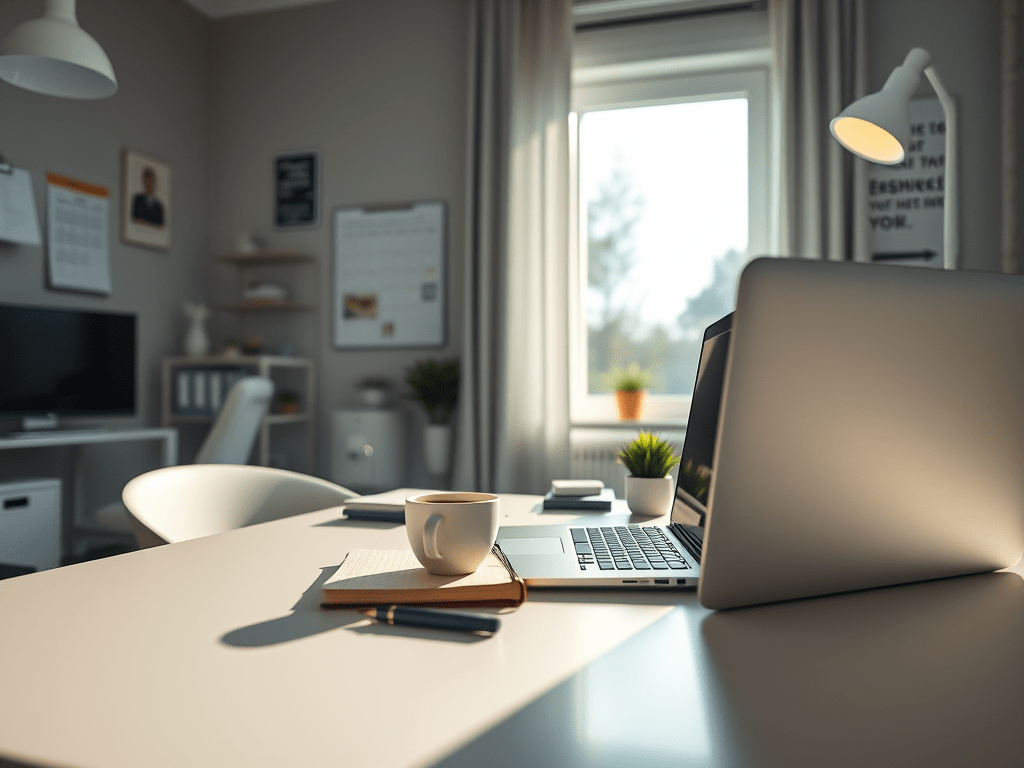
The biggest mistake I made early on was creating a home office that felt cozy rather than energizing. Comfort can actually be productivity’s enemy when it makes you too relaxed to maintain focus and drive.
Environmental factors that boost productivity:
- Natural light exposure — Position your workspace near a window or use a daylight lamp
- Temperature control — Slightly cool 68-70°F (or 20-21°C for my Canadian friends) tends to increase alertness
- Visual cues — Keep inspiring quotes, goals, or project visuals visible
- Organization systems — Everything should have a specific place
- Separation — Clear physical boundaries between work and relaxation areas
The “energy audit” exercise: Walk into your workspace. Honestly assess: Does this environment make you feel energized and ready to tackle challenges? Or does it make you want to curl up and take a nap? Adjust accordingly.
4. Master the Art of Strategic Breaks
Remote work productivity isn’t about grinding through 8 straight hours — it’s about managing your energy like a renewable resource. The most productive remote workers are strategic about when and how they recharge.
Types of breaks that actually restore energy:
Micro-breaks (5 minutes every hour):
- Stand and stretch
- Look out a window at something far away
- Do breathing exercises
- Quick walk around the house
Movement breaks (15 minutes every 2-3 hours):
- Walk outside, even briefly
- Do jumping jacks or push-ups
- Dance to one favorite song
- Yoga stretches
Mental reset breaks (30 minutes mid-day):
- Eat lunch away from your workspace
- Call a friend or family member
- Read something completely unrelated to work
- Take a short walk in nature
Recovery breaks (when you hit a wall):
- 20-minute power nap if possible
- Meditation or mindfulness practice
- Change of scenery (work from a coffee shop)
- Physical exercise to reset energy
The key is being proactive about breaks rather than reactive. Take them before you feel depleted, not after.
Building Your Personal Productivity System
Week 1: Assessment
- Track your energy patterns throughout each day
- Note what environments and conditions help you focus best
- Identify your biggest productivity challenges and distractions
- Document when you do your best work
Week 2: Experimentation
- Try working during your identified peak energy windows
- Test different environmental setups (lighting, music, temperature)
- Experiment with various break schedules
- Create one activation ritual for your most important work
Week 3: Refinement
- Double down on what’s working
- Adjust or eliminate strategies that aren’t helping
- Add one new productivity technique
- Start tracking your daily accomplishments
Week 4: Integration
- Create consistent daily routines around your discoveries
- Set up systems to maintain your most effective practices
- Plan for obstacles and have backup strategies ready
- Celebrate what’s working and plan next improvements
Your Challenge This Week 🎯
Choose one strategy from this post and commit to testing it for five straight days:
Maybe it’s mapping your energy cycles by tracking how you feel every hour. Maybe it’s creating your first activation ritual for deep focus work. Maybe it’s redesigning one aspect of your workspace to be more energizing.
Don’t try to overhaul everything at once. Pick one area where you’re struggling most and experiment with solutions.
What’s your biggest remote work productivity challenge right now? Is it staying focused, managing energy throughout the day, or something else entirely?
Hit up the comments and let me know. I love hearing about what people are struggling with. I also enjoy hearing about what’s working for them. Sometimes an outside perspective can spot solutions you might miss.
Here’s to discovering that productivity at home isn’t about working harder, but about working smarter with your natural patterns.
Talk soon, Tim
P.S. Remember: there’s no “perfect” productivity system that works for everyone. The best system is the one you’ll actually use consistently. Start small, be patient with the process, and focus on progress over perfection. 🌟

 From Desk to Calm